- Home
- Rising damp
Rising damp
Rising damp: we measure before we inject.
Ground water climbs into the brick and leaves a tide mark 50 cm to a metre up the wall. Injection fixes that, on one condition: that it really is the cause. We check first.
What you see
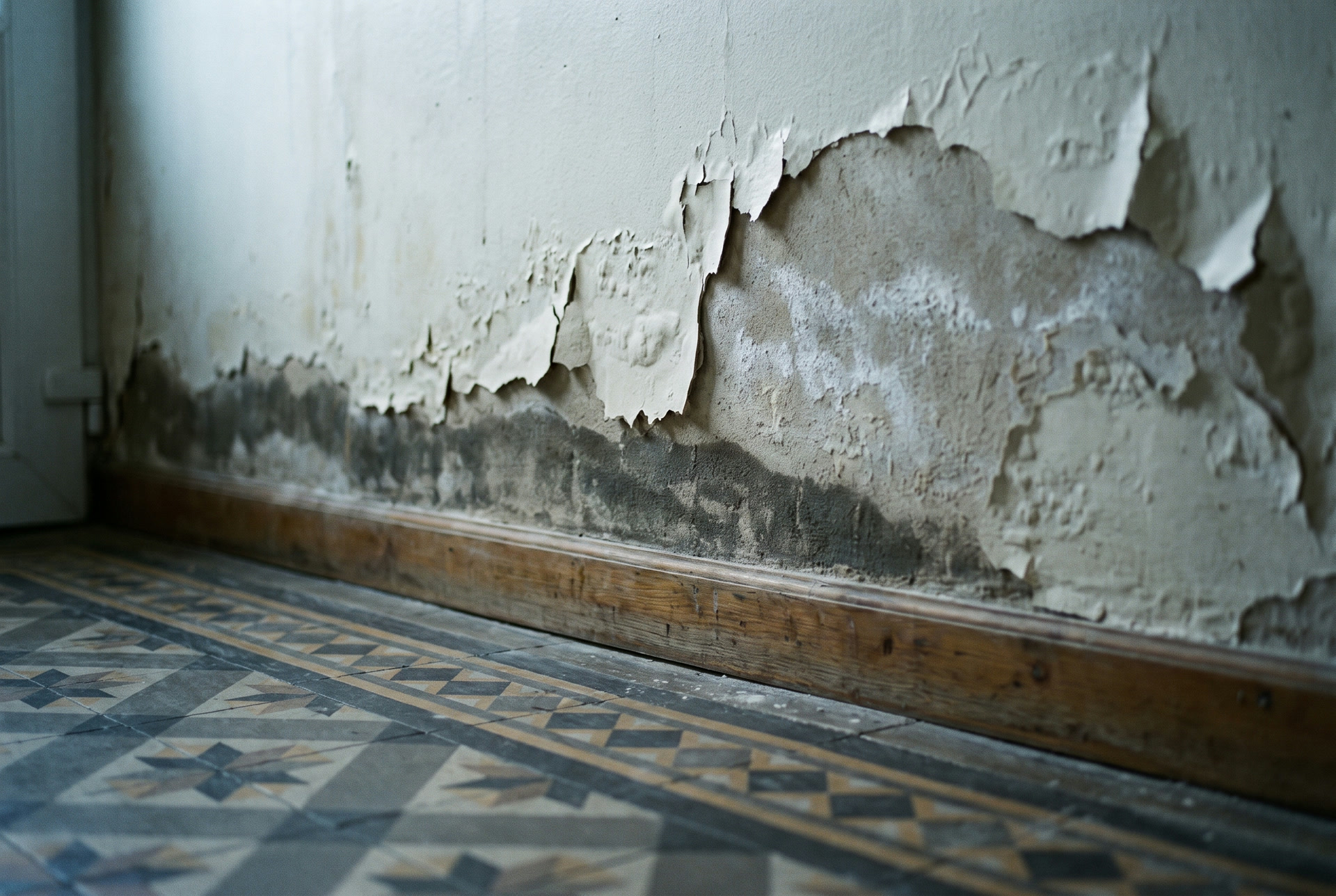
A dark or yellowed band along the bottom of the wall, even, running most of its length. Paint blisters above the skirting, the plaster sounds hollow when tapped, and a white powder appears in patches: salts. Wooden skirting goes black. Winter makes it worse.
Height is the first clue. Rising damp stops where evaporation catches up with the rise, usually between 30 cm and 1.2 m. A stain higher up, or sitting under a window, comes from somewhere else.
Where it comes from
Brick and mortar are porous. Set on damp ground with no damp-proof course, they draw water up like a sugar cube dipped in coffee. Most Brussels houses built before 1930 never had a barrier, or have one that has failed.
The water rises carrying ground salts. When it evaporates, the salts stay in the plaster and keep pulling moisture from the air. That is why a wall that was injected but never desalted stays damp to the touch for months.
What we do
We measure. Moisture readings at three heights, inside and out, and a walk around the house: outside ground higher than the floor, soil against the wall or a leaking downpipe all imitate rising damp and none of them is fixed by injection.
We inject. Holes drilled every 10 to 12 cm along the base of the wall, a silane-based water-repellent cream that spreads through the brick and forms a barrier. On a party wall or a 40 cm wall we adapt depth and quantity: that is where failed injections are decided.
We make the wall sound. Salt-laden plaster is stripped to 50 cm above the tide mark and replaced with a renovation render that lets the wall dry. Then we wait, and we do not paint before the wall is dry.
We finish. Skirting, vapour-permeable paint. The same group does the painting, so there is nobody else to call.
What it costs
On the Belgian market an injection is priced per metre of wall, most often between 80 and 150 € per linear metre, and renovation render between 40 and 80 € per m². Those are indicative ranges, not our rates: yours depends on wall thickness, access and the state of the plaster, and is put in writing after the visit. 6 % VAT if the home is over ten years old.
Questions
The questions we get.
How do you stop damp rising from the ground?
By putting a barrier into the wall at its base, through injection of a water repellent. Then by removing the salt-laden plaster and letting it dry. A surface product only hides it; the water keeps rising behind.
Does injection actually work?
Yes, when the problem really is rising damp and the job is done in full: holes at the right height, enough product, desalting, the right render. An injection applied to a leak or to condensation does nothing, and that is what gives the method its bad name.
How long before the wall is dry?
Roughly a month per centimetre of thickness. A 30 cm brick wall dries over several months, faster in summer than winter. We measure before repainting.
Is it covered by insurance?
Almost never: rising damp is treated as a defect of the building, not an incident. Damage it causes to a recent finish can sometimes be argued, and a measured report helps.
Also
What often goes with it.
Your request
Describe what you see.
We come and measure within five working days, and the written quote follows within 48 hours. The visit is free and you are not committing to anything.
- Phone0467 88 59 52
- WhatsAppSend a photo
- Email[email protected]
- CompanyFreitas Group SRL
BCE 1041.906.890 - LanguagesEnglish, Français, Português
- HoursMon to Fri, 7am to 7pm
Sat, 9am to 1pm